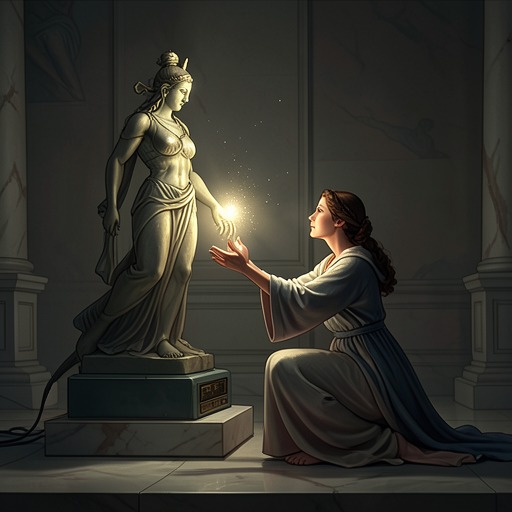
Wax-Figure Curse-Transfer Ritual
Theodosia and the Serpents of ChaosThe Wax-Figure Curse-Transfer Ritual is a method for removing a curse by directing its power out of an afflicted object and into a small wax replica, which must then be burned. The procedure treats magic as exacting practical work: materials, inscriptions, spoken words, timing, and the practitioner’s concentration all shape where the curse goes. Theodosia’s attempt to use it on a cursed statuette demonstrates the danger built into that precision. The hieroglyphs leave the statue, but a distraction diverts them from the intended wax figure into Isis.
Purpose and Prescribed Sequence
The ritual is presented in an old book as a way to neutralize a curse attached to a figurine. Its directions prescribe a wax copy four fingers in height, marked with the indicated hieroglyphs on its base. The practitioner prepares a potion, speaks the specified spell while anointing the cursed statuette, and directs the released curse into the replica. Once the transfer begins, the wax figure must be put into a fire immediately. Burning it is not an optional finishing gesture: it is the final step in the stated method of disposing of the curse.
The book stresses that the potion awakens the spell and activates the curse; the words spoken during anointing direct the active power toward the wax figure. This makes the spoken part more than a verbal accompaniment to the ingredients. The potion initiates a dangerous process, while the correctly spoken spell determines its destination. The instructions give particular weight to maintaining focus once the spell has begun, linking the ritual’s success to sustained attention as well as to the prescribed objects and actions.
The directions do not explain what the activated spell will do beyond setting the curse in motion and directing it. Theodosia notices this omission and is uneasy about proceeding without knowing how bad a mistake might become. Her concern identifies a practical limit in the ritual’s written knowledge: the procedure specifies actions and warns about concentration, but leaves its consequences partly unexplained. The gap matters because the spell is not harmless experimentation; once activated, it can take a course the practitioner may struggle to control.
Materials and Performance
Theodosia makes the required copy from wax she has collected. Her replica is four-fingers-width in conception, though her account emphasizes that it resembles a slender tree trunk with ears more than a cat. She carves the prescribed hieroglyphs into its base anyway, trusting that resemblance is less important than following the written instructions. The imperfect likeness makes the ritual’s operative details conspicuous: the markings and sequence are specified, while the book does not say that the figure must be a convincing miniature of the original.
For the potion, she takes claret from a decanter in her father’s library and combines it with rue, an herb she keeps for magical recipes. She grinds the rue in a mortar with a pestle, then removes her gloves so they will not hinder the fine work. Before touching the statue, she draws a wedjat eye on each palm with a pencil stub, hoping the marks will protect her. She applies the mixture with a clean rag, keeping that barrier between her fingertips and the cursed object, and chants as the book requires. The procedure therefore coordinates preparation, protective marks, controlled contact, anointing, and speech rather than relying on any single ingredient.
As Theodosia chants, the statue vibrates and the sulfur smell grows stronger. Hieroglyphs that had appeared on its surface rise into a buzzing frenzy; where the potion touches them, they shrink. When the potion runs out, they are about half their original size. Still chanting, she watches them pull away from the statue, break free with dull pops, and hover above it like angry bees. These visible changes show the curse responding to the ritual, but they do not yet mean the transfer has reached its intended destination.
Failure and the Importance of Attention
The ritual’s failure turns on a small interruption. When Theodosia reaches the line “Begone you putrid she-cat,” Isis swipes at her ankle. Startled, Theodosia looks down and answers, “Not you.” The words and attention meant to guide the released curse have been disrupted at the critical moment. Instead of entering the waiting wax replica, the hieroglyphs stream toward Isis. They dance across her fur; her eyes grow wild, her ears flatten, and she lets out an unholy yowl.
Theodosia recognizes that the curse has taken the wrong recipient: Isis is no longer behaving as her beloved pet but as a dangerous, bespelled animal. She cannot safely look away long enough to consult the book, and Isis claws her shin before fleeing beneath a bookshelf and continuing to yowl. The replica has not served its purpose, and the required burning of the transferred curse is not shown. The episode therefore makes the warning about concentration concrete: a distraction does not merely interrupt a sequence but redirects the active force, leaving the practitioner with a new threat and no immediate instructions for correcting the mistake.
Relation to the Later Protective Practice
Theodosia later uses a separate protective and healing procedure for Isis, not a completed repetition of the wax-transfer ritual. She makes an amulet from a linen square, drawing a wedjat eye with the burned end of a willow stick. Its stated purpose is to invoke the healing power of Horus and the protection of the Eye of Ra. She wrestles Isis down to tie it around her neck, recites a charm, and throws water after her as she runs through the door. These actions show Theodosia attempting to respond to the harm caused by the misdirected curse, but the account here does not establish the eventual result.
The contrast clarifies what the wax method is designed to do. Its prescribed endpoint is removal and destruction: the curse should leave the statuette, enter a prepared wax figure, and be consumed by fire. The later amulet instead offers protection and healing through a marked object, spoken charm, and purifying water. Together, the practices present magic as procedural and vulnerable to error, yet not reducible to a recipe alone: objects and words must be used in the right order, and the practitioner’s attention is part of the mechanism.